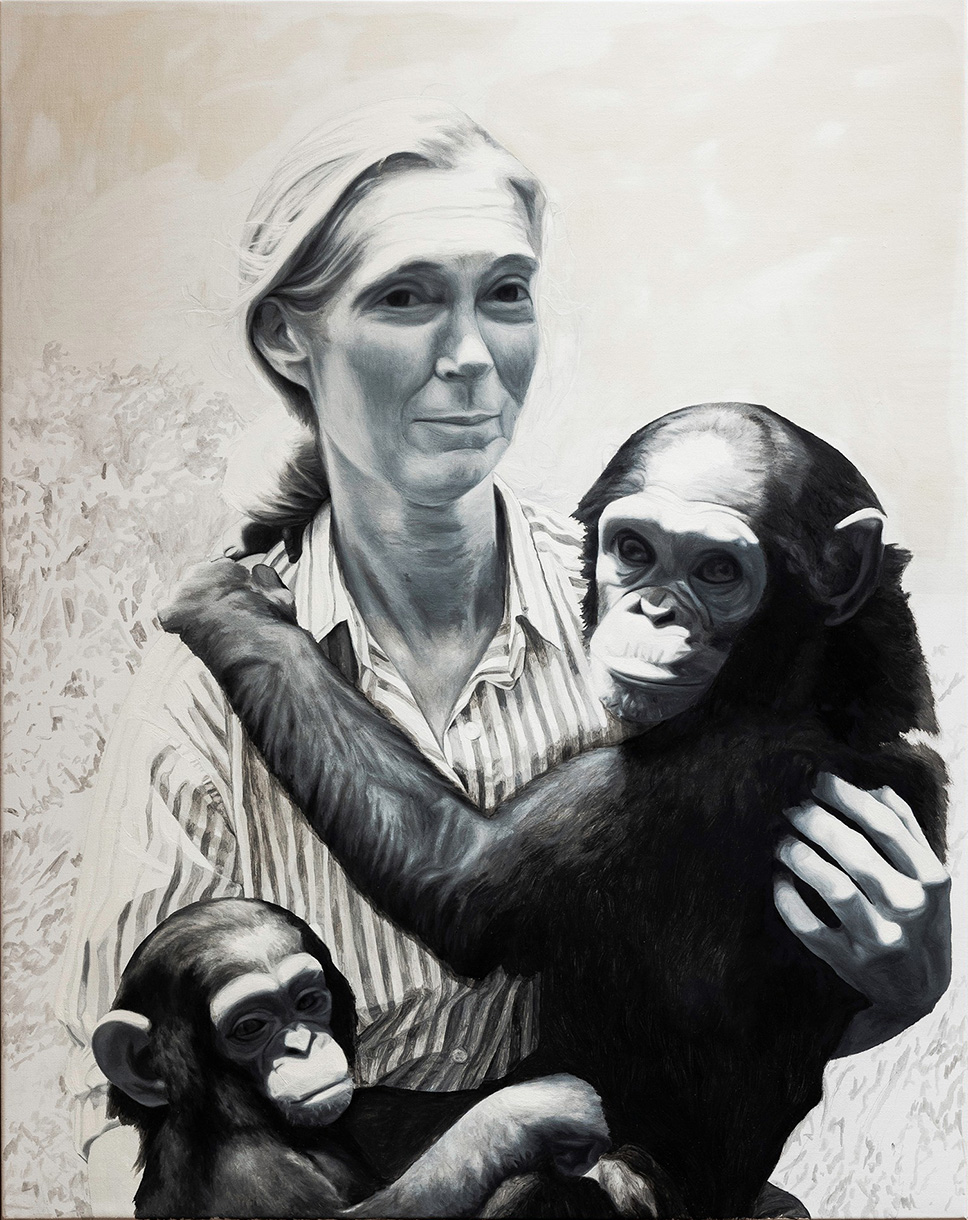
Hamishi Farah, Untitled [Utan titel], 2026, Courtesy of the artist Arcadia Missa, London and Maxwell Graham, New York
Untitled, 2026
Hamishi Farah
Runtime: 01:35
Hamishi Farah: Hello, my name is Hamishi Farah, I am Somali, I grew up in Australia. I live in Germany. This work is an oil on linen painting. The woman figure is recently deceased British primatologist Jane Goodall with two chimpanzees in her arms. The wall label cites a quote from Georges Didi-Huberman’s Fra Angelico: Dissemblance & Figuration, and a quote from Hortense J. Spillers’ Mamas Baby, Papa’s Maybe.
The painting is based on the iconographic type depicting the Madonna with both Jesus Christ and Saint John the Baptist as children, and apocryphal innovation developed in late 15th century Florence, where the inclusion of Saint John the Baptist as a child renders him as the prefiguring of Christ’s martyrdom. The devotional machinery of prefiguration didn’t disappear from images but was repurposed to consecrate entirely different systems of meaning.
In the visual culture of racial capitalism, the same pictorial syntax that substituted race for salvation posed and framed black subjects within a symbolic order that made their assigned destiny appear natural, inevitable, and divinely ordained. The pictorial syntax persists precisely because it operates below the threshold of declared meaning, what Didi-Huberman would recognize as the images’ capacity to survive its own context, migrating across centuries while retaining the structural grammar of its original violence, and what Spillers names as the unmaking of the body into flesh.
The stripping of the social and symbolic standing that racial capitalism required was not achieved despite this visual culture, but partly through it. The devotional machinery of the symbolic order conscripted to make that unmaking appear as it always had divinely ordained.