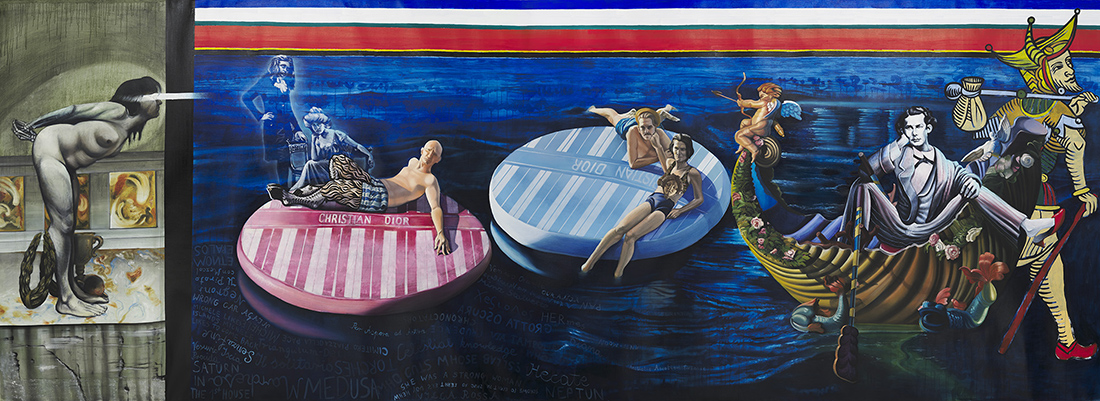
Mikołaj Sobczak, Parole, Parole, Parole (Ord, ord, ord), 2026. Med tillstånd av konstnären och Capitain Petzel, Berlin. © Mikołaj Sobczak 2026 Foto: Patrick Zier. Med tillstånd av konstnären och Capitain Petzel, Berlin.
Parole, Parole, Parole, 2026
Mikołaj Sobczak
Runtime: 04:27
Mikołaj Sobczak: My name is Mikołaj Sobczak, and I would like to talk about my painting Parole, Parole, Parole.
Together with a group of friends, I travelled to Capri to research queer resistance during the time of Nazi persecution, when the island functioned as a kind of refuge, almost a mythic sanctuary for queer lives. One evening, drinking wine, we asked ourselves a simple question: what if, instead of studying history, we start to produce it?
That question changed something fundamental in how I think about history. In ancient Greek mythology, history has its muse: Kleio. In this painting, she stands in the space adorned with marbles inspired by Fra Angelico – a sacred, meditative interior.
She observes the world from a bunker, through a narrow opening. Her vision is limited. This painting is dedicated to all those whom history overlooked or refused to see.
Hannah Arendt, in her 1951 book The Origins of Totalitarianism, suggests that loneliness is one of the roots of political radicalization. Today, in late capitalism, we are constantly told that success depends solely on individual talent and effort.
At the same time, political forces mobilize masses. Between these two pressures, I feel that only small, informal constellations of friendship can offer resistance.
So here we are: myself and my friends Hendrik and Arnisa, floating on Christian Dior mattresses in Anacapri. After visiting the Grotta Azzurra, with its almost metaphysical blue light, we wandered into a luxury hotel sponsored by Christian Dior.
We hacked the system a little, slipped into their beach, swam among influencers staging their perfect images, and became, almost accidentally, a kind of counter-presence.
But in the painting, we are not exactly ourselves. We appear as mythological figures: Pan, Minerva, Mercury. Not because mythology elevates us, but because it reveals something else. What we often perceive as destiny or divine guidance might, in fact, be systems – economy, desire, circulation – shaping our lives.
We are not isolated individuals, self-made and autonomous, but part of a larger network. The Greek gods became, for me, a metaphor of that invisible structure.
On the right, Ludwig II of Bavaria, the last Bavarian king – and rumour has it, gay – sits in his boat inside the Venus Grotto, a space he built at Linderhof Palace inspired by Capri’s Blue Grotto.
Nearby appears the Fool from the tarot, the figure of zero and new beginnings, stepping almost out of the painting. Across the surface, across the surface of the water, fragments of language drift: phrases, jokes, distortions we collected during the trip.
Above them, a writer, Natalie Clifford Barney, and her partner Renée Vivien – because at some point, as a joke, we began telling everyone we were writing Barney’s biography, and then fully committed to it.
Trust me or not. But we still carry her ghost stuck to our backs.
At the very top, an abstract band. A diagram based on the colour proportions of flags of totalitarian regimes on the horizon. Something seems to be returning. Hey, Fool, maybe it’s time to leave?
Parole, parole, parole.