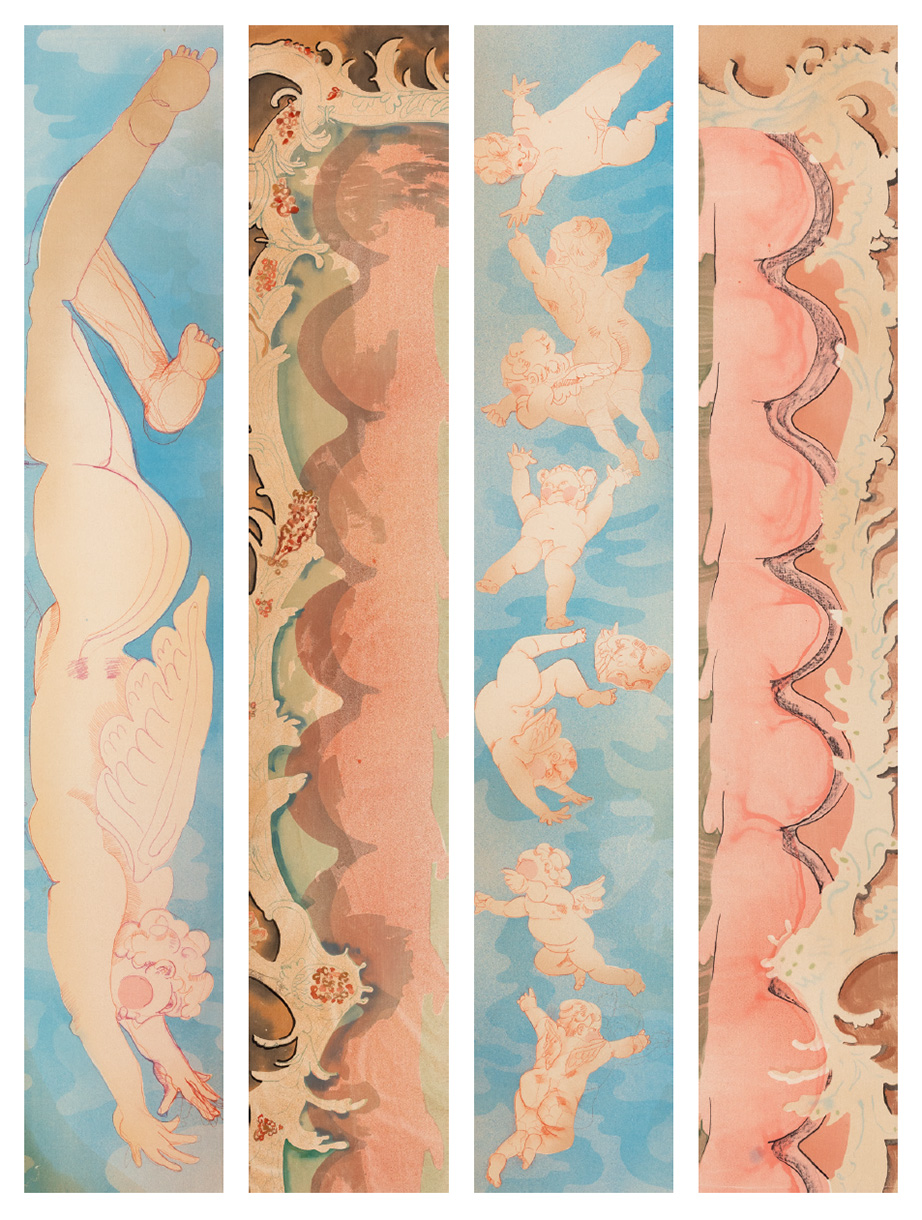
Domesticating Heaven [Att tämja himlen]: Gay Caryatid; Groups of Children in the Sky; Innocent Repetition; Putti Psychobiography [Gay karyatid; Grupper av barn i skyn; Oskyldig upprepning; Putti – en psykobiografi], 2026 Akryl, kol och färgpennor på duk/ Acrylic, charcoal and colored pencil on canvas Courtesy of the artist and Mendes Wood DM, São Paulo, Brussels, Paris, New York
Domesticating Heaven, 2026
Matthew Lutz-Kinoy
Runtime: 05:09
Matthew Lutz-Kinoy: My name is Matthew Lutz-Kinoy, I am an artist from Brooklyn New York. I work across large format painting and drawing, performance, and ceramics. Over the past ten years my studio has been based in Paris, France. This series of four paintings is titled Domesticating Heaven. They are painted on unprimed canvas and stretched over aluminum stretcher bars. Their tall format reminds me of columns or architecture that hold things up.
The format of these paintings, as tall and narrow panels, recalls a specific moment in the work of the rococo artist Jean-Honoré Fragonard, when, in the years surrounding the French Revolution, he left Paris and retreated to the countryside, to his family’s home in Grasse. At this point, the system of aristocratic patronage that had sustained his career was collapsing, and his position within the Salon and the public sphere was becoming increasingly unstable. In Grasse, he reinstalled earlier decorative works, including The Progress of Love, within a domestic interior, while also producing a series of elongated panels designed to be set directly into the architecture of the home.
These works remind me, then, of both a social withdrawal and an adaptation, a movement away from public ambitions toward a more intimate, domestic mode of production, shaped by the conditions of patronage, his displacement, and survival. The tall, narrow format, then, carries with it a sense of displacement, architecture that follows and tells this story of refuge.
In this way, the paintings operate within a field of decoration and structure, freedom and confinement, ambition or support. In thinking about the House of Nisaba, I was interested in how painting and architecture might converge within these conditions, how images can function as both aesthetic objects and structural elements.
In my painting Gay Caryatid, there is a painted image of a long row of stacked butts in an endless column, along the side a frame of twisted rocaille lines which bracket the plump, fleshy butts. I am thinking about the caryatid, typically the female column figure because the male version would be called an atlas, a man who doesn’t hold up something practical like a roof, but an abstraction, the sky, or in our common current knowledge, the world. Whereas the caryatid is typically effortless, the male version is suffering and expresses the strain.
What interests me is the moment when the human form is load-bearing and ornamental, the body is a decorative structure, and it holds something in place. The merging of body and architecture relates to a broader interest in forms of representation that move outside of language, where meaning is constructed with rhythm, movement, and visual relation rather than in words. Narratives are formed in relation to architecture, image, and the negative space of the human forms that populate the room. In this sense, painting can be read almost musically, as a sequence of gestures and colors that reorganize and open up meaning.
This question of how support as in architectural or economic support shapes what an image can be, I continue to explore this in the painting Groups of Children in the Sky, a title taken from a work shown by Jean-Honoré Fragonard at the Salon of 1767. Instead of presenting a major history painting as he was known for, he exhibited a sketch for a decorative ceiling, which provoked strong criticism. Denis Diderot, and others, saw his turn toward decoration and patronage as a sign that the artist was abandoning his intellectual and moral ambitions in order to satisfy a market. At that moment, painting was supposed to aspire upwards toward history, or the virtue of public meaning making. For Fragonard to turn toward interiors, toward ornament, producing the desires of his patrons, was seen as conceptually and intellectually diminished. Diderot suggested that under the pursuit of money the artist risked losing not only ambition, but the very sense of the beautiful, exchanging it for the quick fix of ease and charm.