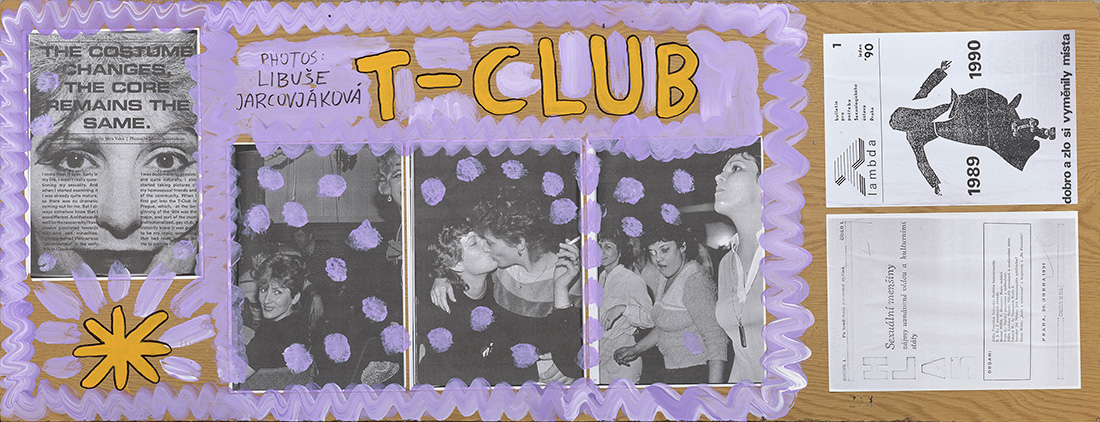
Karol Radziszewski, Detail, The Classroom/Klassrummet, 2023 © Karol Radziszewski 2026 Photo: Tobias Fischer/Moderna Museet. Top side, school desk.
The Importance of Queer Archives in Central and Eastern Europe
Runtime: 01:10
UE: You told us about the Queer Archives Institute. Why is it so important to create an archive around these histories?
KR: You know, I was born in Białystok, the town in northeast Poland. I was growing up in the 80s and beginning of the 90s, and every time I heard something about gay queer people, it was something that came from the West.
This constant story of not having an own identity, our own history, was very present when I was growing up and also when I studied. The artists I was referencing, they were artists from the West, so-called West, and North America.
So that was, for me, quite natural to search for my own queer ancestors, not only in Poland but in the whole region. And that’s how it all started, and how the idea of archiving and writing our own history became important and kind of leitmotiv of all my artistic practice.
In my films, installations, also in the paintings, portraits, it’s all based on the rediscovering or rewriting, or rather writing (for the) first time this history.