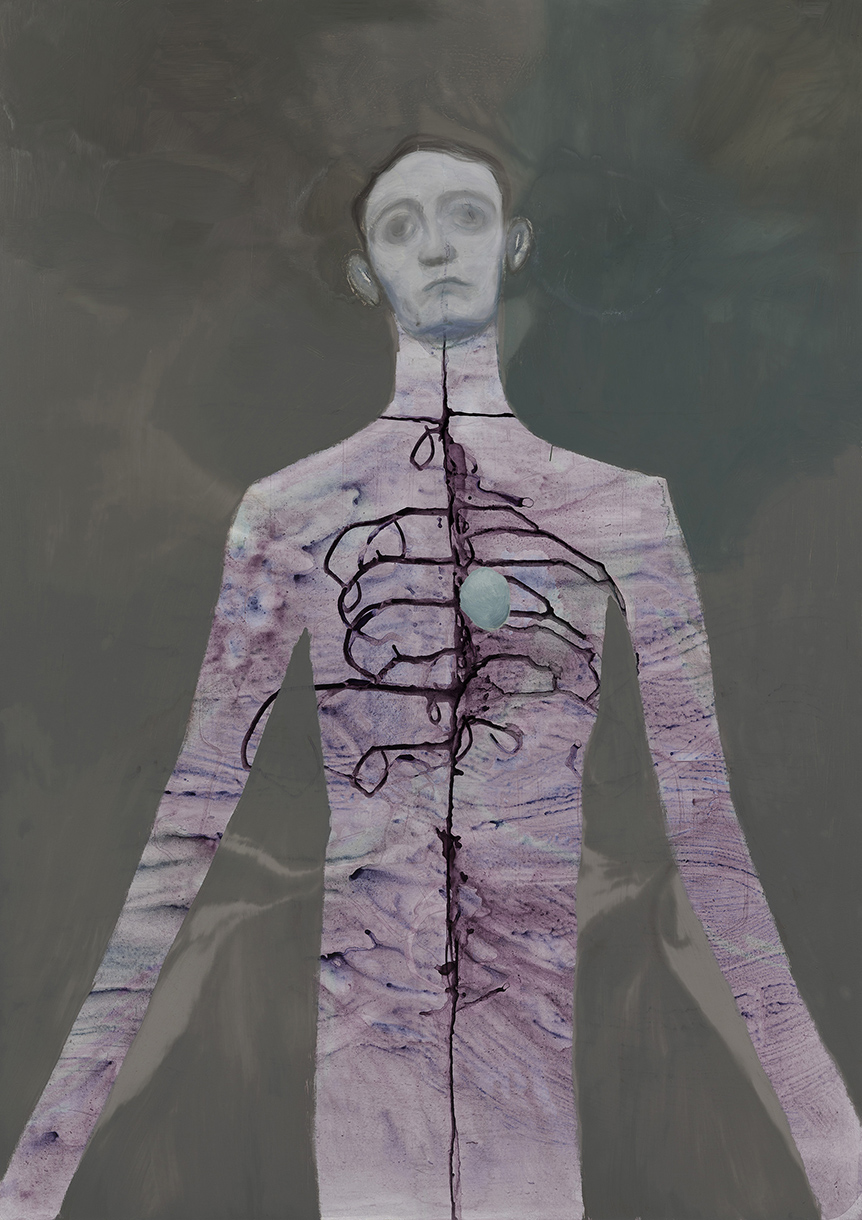
Sanya Kantarovsky, Scarecrow (Fågelskrämma), 2025. Moderna Museet. Donation 2025 från Arif Suherman. © Sanya Kantarovsky 2026 Foto: Pierre Le Hors. Med tillstånd av konstnären och Michael Werner Gallery
Scarecrow, 2025
Sanya Kantarovsky
Runtime: 04:36
Sanya Kantarovsky: My name is Sanya Kantarovsky. I’m a painter and artist based, between New York City and upstate New York. I was born in Moscow in the USSR and immigrated in the early 90s. This work is called Scarecrow, and it shares that name with the exhibition that it was first shown in in the spring of 2025 at Michael Werner Gallery in New York.
This painting came out of a motif that I’ve worked with several times in the past. That would entail a kind of inner workings of the body laid bare, suggesting some kind of translucency or transparency or in some instances, a kind of decomposition of the exterior body to reveal the interior.
And I was thinking about this both in terms of a kind of, metaphorical idea that also mimicked or echoed, the structure of a painting itself, which has a kind of skin, that is stretched over some sort of support containing a painted event on its surface.
And I was thinking a lot about the historical, various historical modes of figuration and how those have changed over time. So, for instance, things like torsion of the body or various positions of the body that are meant to reflect some kind of interior activities such as thought, when we think about Rodin, (let’s say) or pain, such as, Michelangelo’s Dying Slaves, and then this sort of transition to a kind of mannequin like body that we see, with the onset of figuration within modernism.
And, the face of the figure is, almost, Etruscan or Babylonian in a sense, because I wanted to kind of forgo, I wanted to combine several different modes of, representation into one.
And, also, I was thinking a lot about Sigmar Polke and his use of, you know, his, like, experimenting with, material and paint and creating an interesting cognitive dissonance or rupture between, the material and what that material is meant to describe or embody.
And so here, the body itself is a kind of hole in a layer of skin in the painting, in this olive drab background, which is strange because it’s a, it’s optically or illusionistically, meant to be read as a background, but when you actually regard the object, it is in the foreground and the body itself is a kind of void, a kind of hole in the surface.
And then there’s also a strange relationship between two very different kinds of material. There is the interior of the body, which is painted with a very kind of translucent and ethereal watercolour, and then the head and the background, which are painted in a more sculptural, more substantive, material of oil paint.
My work isn’t really meant to be explained or understood or seen through any particular aperture or idea. I’m very interested in paintings as kind of fugitive things out in the world, and the way that they gain value and meaning in the mind’s eye of the viewer. A friend of mine once said that the actual artwork exists somewhere in the air between the viewer and the surface of the painting. The surface, the painting itself is just an object. And this painting is no exception. It is a very open-ended proposition. And, it’s meant to have a relationship to the body, a relationship to feeling, a relationship to a kind of register of looking and feeling. And that’s it.