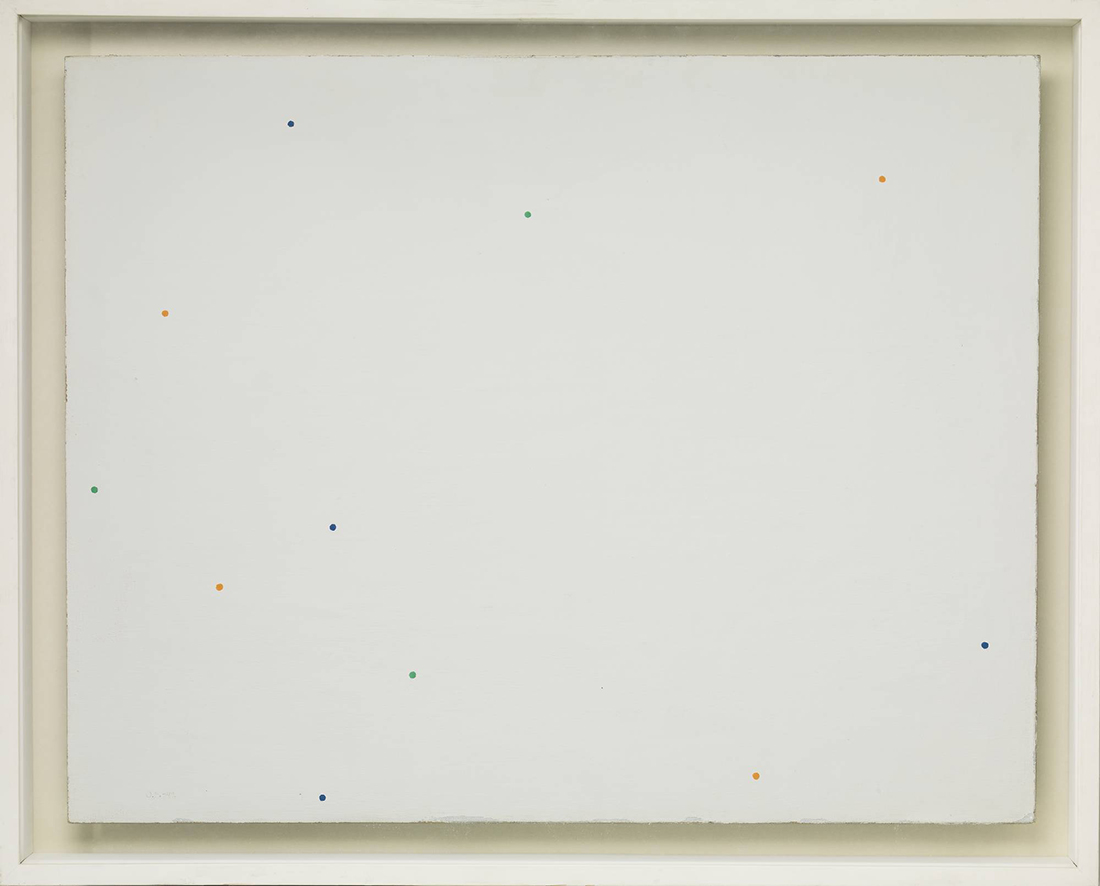
Olle Bonniér, Jing-a-ling, 1949. © Olle Bonniér/Bildupphovsrätt 2026. photo: Prallan Allsten/Moderna Museet
Ding and Jing-a-ling, 1949
Olle Bonniér
Runtime: 01:37
Narrator: Ding and Jing-a-ling by Olle Bonniér, from 1949
Let’s look together at Olle Bonniér’s works from the series Ding and Jing-a-ling.
We see coloured dots against a white background.Notice how the dots relate to one another. And notice the space between them.
When Bonniér made Jing-a-ling in 1949, he believed that what was new in art was not simply a matter of visual form. As he put it: “Anyone can produce these white surfaces and dots.”
For Bonniér, this was not about painterly skill in the usual sense. It was about a vision. He imagined the white surface as an endless, self-luminous universe.
In his mind, the dots moved through this universe along unpredictable paths. Now and then, two of them happened to collide. And when they did, the “Jing-a-ling” sounds came into being.
Bonniér also imagined that Jing-a-ling could be interpreted and performed as music. It took more than 30 years before the first musical interpretation was performed. Since then, several others have followed.
Now it’s time for a question:
Choose one of the paintings in the room.
What would it sound like if you sang it? Or played it on an instrument?
Sound Effect by freesound_community from Pixabay